Linslow Industries · Trend Report 01 · October 2026
Linslow has run Happy Mail, a creator mail club, for eight monthly shipments: the billing, the labels, the mailing record, the customer service. In 2026 we counted every listed club, profiled fifteen, re-checked their prices and talked with the operators.
We publish this because more of what people see online is machine-made, and a paid monthly envelope from a real person is one way to measure what that person is still worth to an audience.
Linslow Industries · Trend Report 01 · October 2026
Photographs: Baker’s Dozen Print Club and Architecture Mail Club
2 / 24
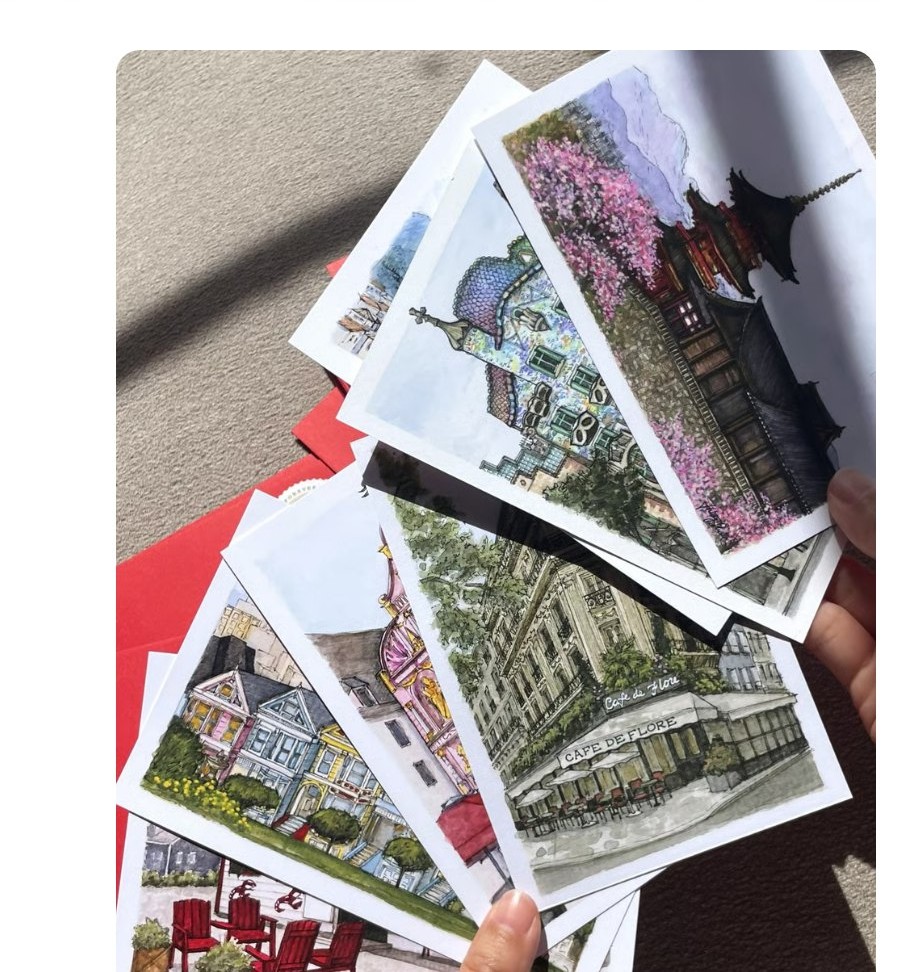
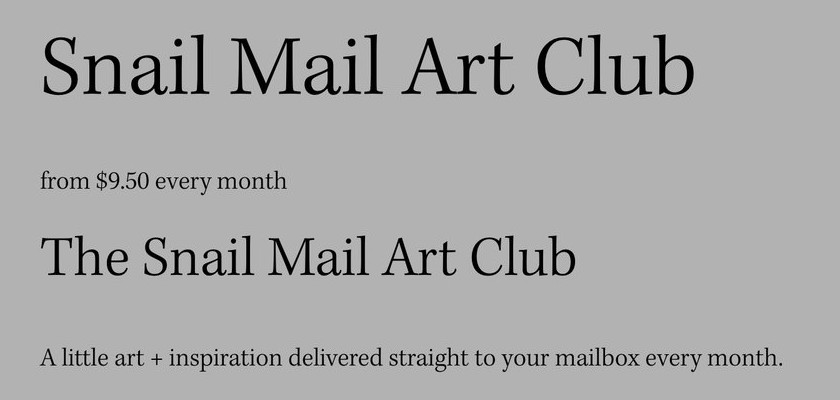
A month of postcards from a city-sketching club (artsbytrinity.com)
Why this report
We run one. So we counted the rest.
Linslow has run Happy Mail, a creator mail club, for eight monthly shipments: the billing, the labels, the mailing record, the customer service. In 2026 we counted every listed club, profiled fifteen, re-checked their prices and talked with the operators.
We publish this because more of what people see online is machine-made, and a paid monthly envelope from a real person is one way to measure what that person is still worth to an audience.
Nobody had counted this field. We run a club, so we did.
3 / 24
The report, plainly
1,300 clubs, one answer, one ceiling.
The product. One flat envelope from a creator each month, about $10, one stamp, sold to the audience she already has, packed by her. About 1,300 listed clubs, two in three in the US, all arrived at this format. At 200 subscribers and $10 a month the listed clubs make about $30 million a year between them.
Why it works, and why it stays small. One stamp instead of a shipping operation, so about $6 of each $10 is margin before the creator’s time. About 2 to 3% of a following subscribes, whatever its size, so a club cannot get bigger than its creator’s audience, and the creator packs everything herself. Our own club is a few hundred envelopes for the same reasons.
What changed, and what we do not know. Software and AI now do about two thirds of the office work in a shipping cycle. Packing is what is left, and packing can be hired out. Nobody has tested whether subscribers stay when someone else packs. Here are five ways to find out.
We ran one, we counted the rest, and they all work the same way.
Sources: notes 3, 4, 6, 7 and 9 (A11)
4 / 24
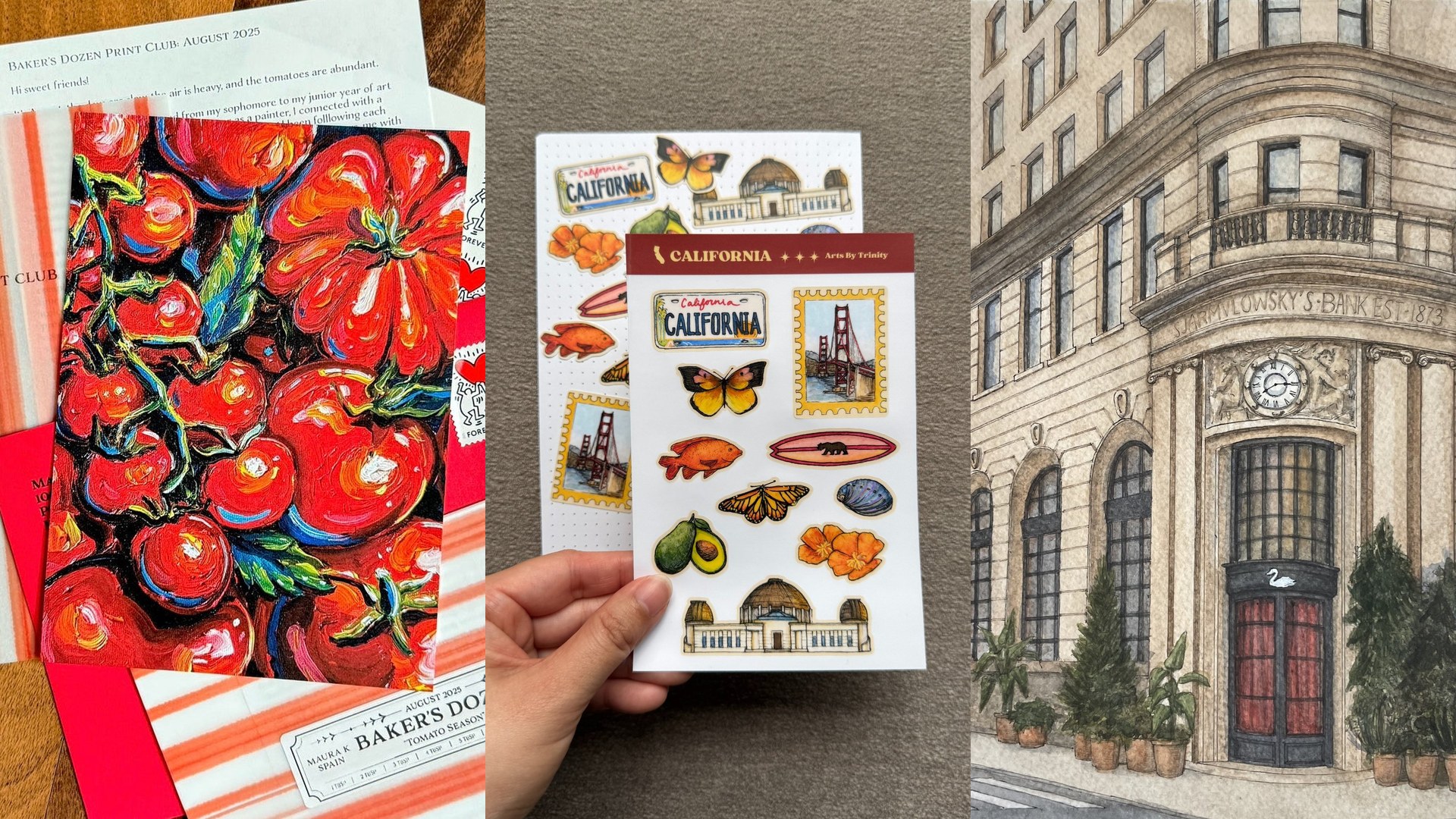
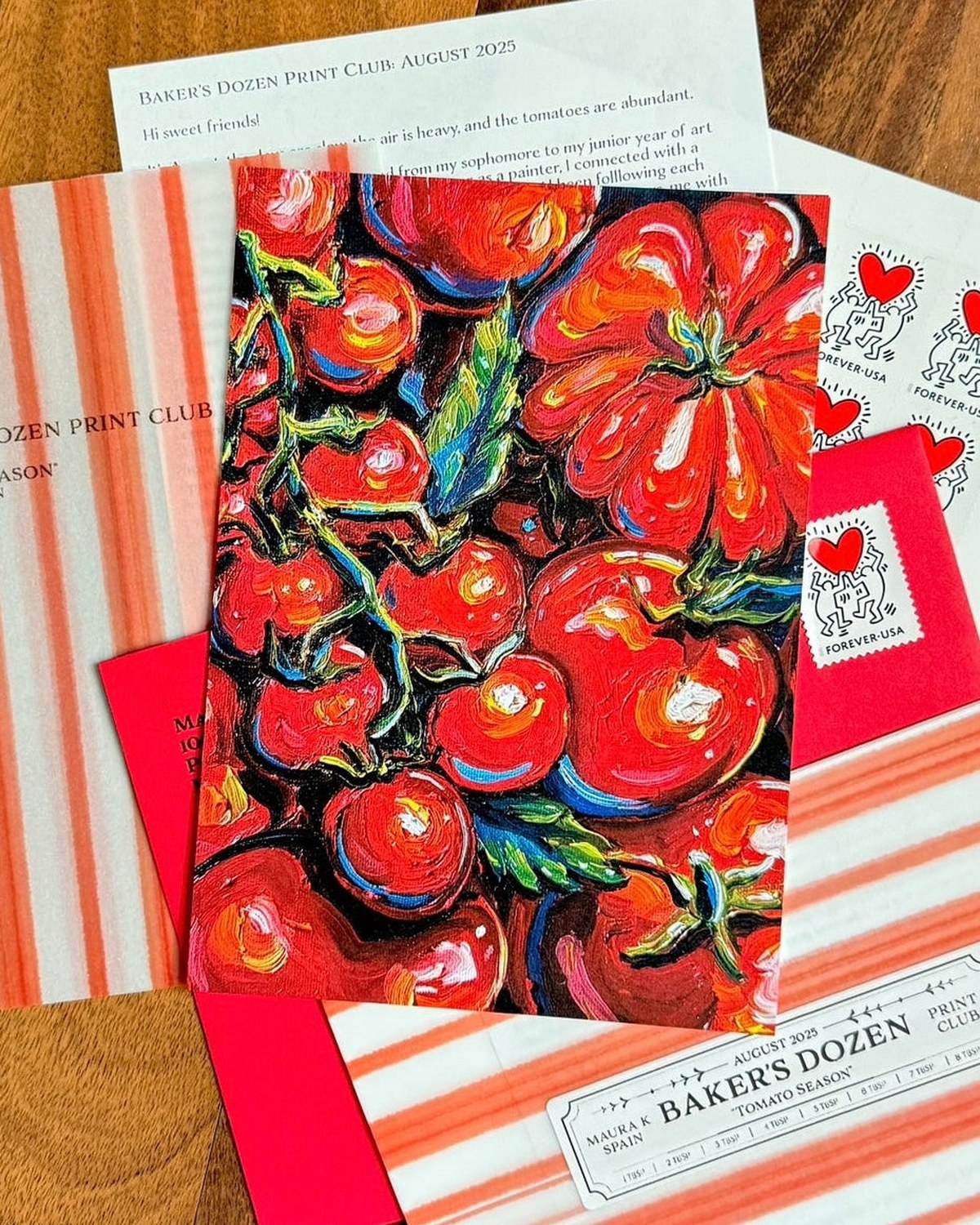
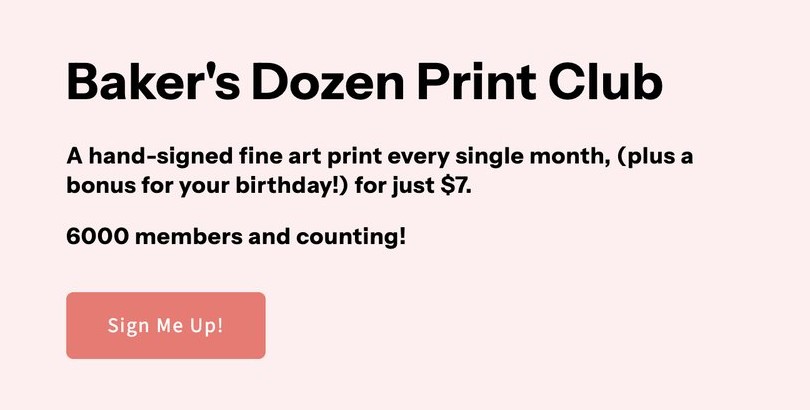
One month of the Baker's Dozen Print Club: a letter, a signed print, a stamp (maurakspain.com)
The thing
An envelope, a stamp, ten dollars.
Inside: a print, stickers, and usually a letter.
Under one ounce, so it mails on one first-class stamp: no box, no tracking, on a fixed day each month. Subscribers pay monthly or prepay a few months. The creator makes the contents, packs them at a table and mails them.
The letter is the part they keep paying for.
Sources: notes 1 and 9 (A11)
5 / 24
The thing
Art, letters, stickers, prints.
Four tags cover most of 1,312 listed clubs.
Figure 1Clubs carrying each category tag, count and share of 1,312 listed clubs, October 16 2026
Everything else is a small share: faith, kids, recipes, zines, poetry.
Sources: note 9 (A11)
6 / 24
The thing
The field converged on ten.
Nine in ten clubs charge $5 to $16 a month, whatever is inside.
Figure 2Monthly price by category tag, one dot per club, n = 1,189, October 16 2026
Nobody coordinated this. A thousand people priced the same envelope and landed on $10.
Sources: note 9 (A11)
7 / 24
The thing
American because the creators are.
Two in three ship from the US; the stamp is not why.
Figure 3Listed clubs by the country they ship from, n = 1,323, October 18 2026
Most foreign letter rates are cheaper per gram than the 82-cent US stamp. The 237 clubs priced in euros or pounds sell the same envelope at a slightly higher median. The difference is where the creators and the directories are, not the postage.
Every major post office sells a flat letter rate. The US has the creators and the directories.
Sources: notes 9 and 11 (A11)
8 / 24
A frame from the creator’s own video, “How I got people excited to spend $9 on my art” (@artsbytrinity, Instagram), cropped to the frame
The thing
The packing table is the ad.
The video of this month’s packing sells next month’s subscription to followers the creator already has on TikTok and Instagram. Nothing is bought. The work is the content.
The marketing budget is a phone pointed at the packing.
Sources: notes 7 and 10 (A11)
9 / 24
Why it works
One stamp is the shipping department.
The same envelope as a tracked parcel loses money.
One envelope, one stamp
Price
$9.00
Materials
2.00
First-Class stamp, 1 oz
0.82
Card fees
0.56
Margin
$5.62 (62%)
Flat, under an ounce, no box, no tracking. Worked at $9; at the field’s prices ($8.88 to $10) the margin runs $5.40 to $6.50. Photograph: maurakspain.com
The same envelope as a tracked parcel
Price
$9.00
Materials
2.00
Tracked parcel rate
6.50
Card fees
0.56
Margin
–$0.06
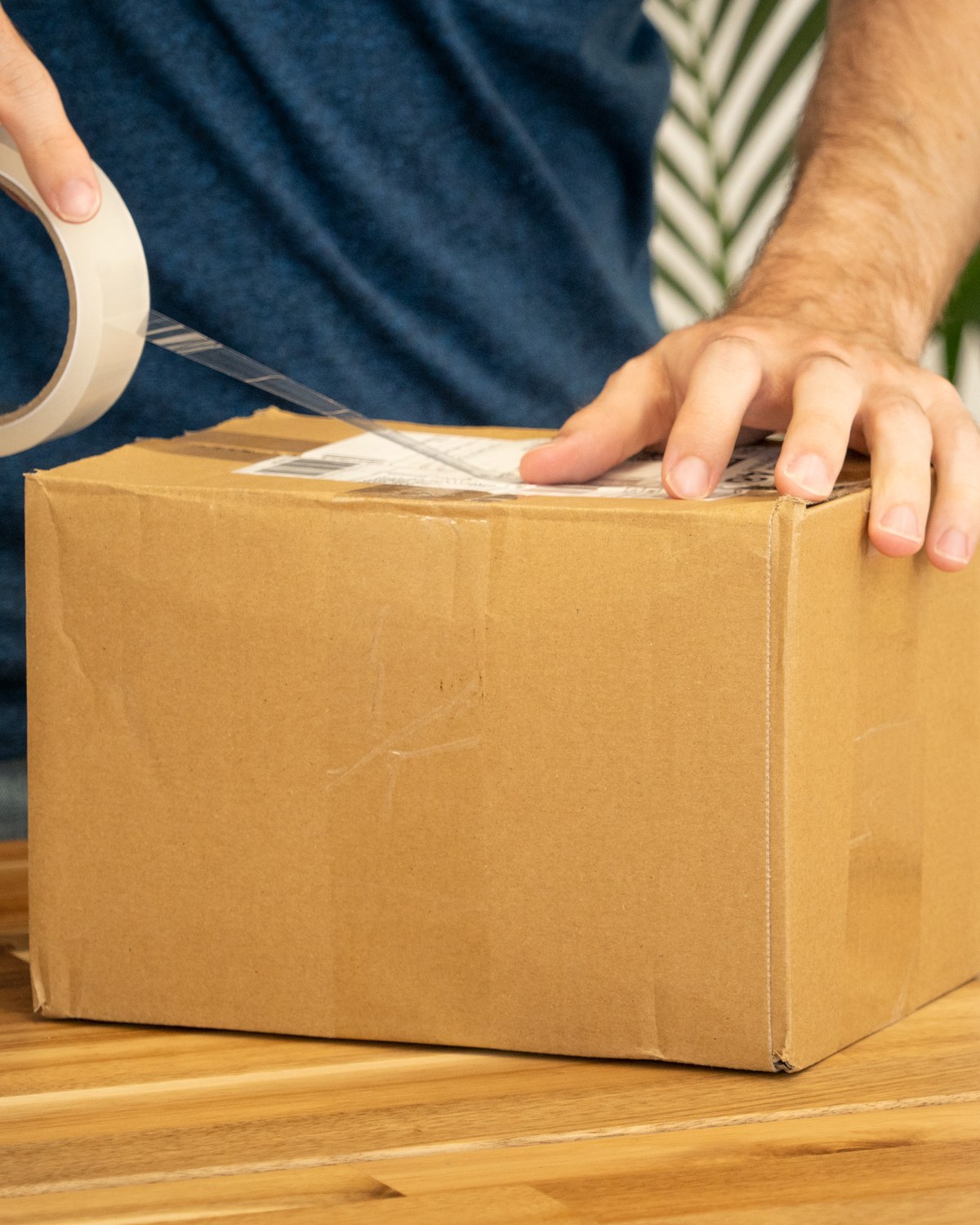
About $6.50 is a retail tracked-parcel rate. Boxes, dimensional weight and a carrier account are what sank the 2019 subscription-box wave. Photograph: Meanwell Packaging, CC BY 2.0
Add tracking and the margin is gone.
Sources: note 4 (A11)
10 / 24
Why it works
A thousand envelopes is a living.
About $5,600 a month of margin, before her time.
Worked at $9 with $2 of materials, one stamp and card fees. At the field’s $10 median, add about $1,000 per thousand envelopes. At 2,700 subscribers the model gives about $14,600 a month.
Figure 4Monthly cost and margin by envelope count, $ thousands
The model is conservative. One operator’s own number for May was $18,300.
Sources: note 4 (A11)
11 / 24
Why it stays small
Fifty to two thousand in a year.
One craft creator; her mother is her only helper.
About 25,000 Instagram followers. Opened in mid-2025 with 50 subscribers at $8. Near a thousand in three months. A waitlist in January. Around 1,500 she slowed her own posting on purpose. “My main helper is my mom, honestly.”
2,000
subscribers in a little over a year, from 50, at $8 a month. Two people pack.
The subscribers were already following her. The club gave them something to buy.
Sources: note 3 (A11)
12 / 24
Why it stays small
Bigger audiences do not convert better.
5,200 followers convert at 19%; four million at 0.02%.
Seven of 1,323 listings state a count. For nine clubs a following and a count both exist, three of them through the press: the four under 30,000 followers convert at 3% to 19%, the five above at 0.02% to 3.3%.
Figure 5Share of Instagram followers who subscribe, clubs ordered by following, n = 9, October 18 2026
*A Patreon member count that includes free members: an upper bound. Subscriber counts on A4.
Past 100,000 followers, 2 to 3% subscribe, no matter who.
Sources: notes 7 and 9 (A11)
13 / 24
Why it stays small
The platforms stop at the CSV.
Shopify or one of two new mail-club platforms; the creator packs.
MailClubly
Posthouse
Shopify, with a subscription app
What it is
Launched 2026. A public directory of 1,119 clubs with a storefront page each; 508 sell through it. Stripe, one cutoff a month, a cap with a waitlist, a CSV of addresses at the end. Free at an 8% fee, or $12 a month.
Launched 2026. “The operating system for snail mail clubs.” Monthly batches with a cutoff, a cap with a waitlist, failed payments held out, a CSV of addresses. Free to $100 a month of sales, then 4.5%; or $49 a month. Eighteen clubs.
A general store with Recharge or native subscriptions on top. Bills on the signup date unless the operator builds a cutoff; no batch, no cap, no waitlist. $39 a month plus the app. 438 listed clubs; nine of the fifteen we profiled.
For an operator
Live in an afternoon, and the directory sends traffic. Against: 8% is the costliest stack past a few hundred envelopes ($800 a month at 1,000); labels, the record and the exceptions are still yours.
The batch logic the field needs (cutoff, cap, held failures) without an app stack, at a lower take. Against: eighteen clubs is a small company’s risk; no directory, so no traffic; labels and the record still yours.
The field’s default: the largest clubs run on it and it sells everything else the creator makes. Against: the cutoff, the batch and the record are a spreadsheet every morning until someone writes them.
For a partner
One CSV format for the whole base, so a label or fulfillment layer plugs in once. Against: no app store yet; a partner is one feature away from being built in.
Built around the batch, so a label or fulfillment service has a natural seam. Against: a small base to sell into.
438 clubs and an app store: an app that adds the batch, the labels and the record reaches the top of the field. Against: Recharge or Shopify can add the cutoff themselves.
For an acquirer
The directory is the discovery asset, and it compounds if the field does. Against: young and self-listed; it doubled once by importing listings; the largest clubs are not on it.
The workflow is right and the team is early. Against: eighteen clubs, and either rival can rebuild the storefront.
Not a target at this scale. The opportunity is the app layer (slide 19).
The platforms take the money and hand back a list of addresses. Everything after that is the creator’s problem.
Sources: notes 6 and 9 (A11)
14 / 24
Why it stays small
We cut the hours. We did not grow.
Our own club is still a few hundred envelopes.
Happy Mail runs on software we wrote: the batch, the labels, the record and the problem cases take minutes on shipping day. The club is the same size. At a few hundred envelopes the work was never the limit; demand was, and demand is the creator’s audience times 2 to 3%.
A mail club sells to followers the creator already has. It does not make new ones.
2 to 3%
of a following subscribes, whatever its size. The club is capped by the audience, and the audience by the hands that pack.
Software made the club easier to run. It did not make it bigger.
Sources: notes 5, 7 and 9 (A11)
15 / 24
The turn
Two thirds of the work just left.
What remains is the art and the packing.
Until 2025 every step at the clubs we met was a person and a spreadsheet. The platforms took over billing; our scripts and an AI assistant took over labels, the record and the problem cases. The creator still makes the art and packs the envelopes.
Figure 6Hours per ship cycle by step, before and now, at a few hundred envelopes
Box width is the hours a step took at a club of a few hundred envelopes, from Happy Mail’s logs and the operators’ accounts in September; est. marks an estimate. The record step runs 27 minutes unattended.
Packing can be hired out. Whether subscribers stay when it is, nobody has checked.
Sources: notes 3, 5 and 6 (A11)
16 / 24
What it means
Durable is not the same as growing.
Sixty percent margin on a ten-dollar product. No way to scale it past one person.
These clubs last because the numbers are simple: a $10 envelope costs about $3.50 to make and mail, there is no inventory and no shipping contract, and if a subscriber leaves nothing is lost but the subscriber. They stay small because the creator packs every envelope herself, and the clubs that could grow past that point close signups or start a waitlist instead. It is a good product and a useful addition to a creator’s business.
There does not seem to be scale in it. A single club does not look like it can become a large company. And nobody is asking for mail on its own: subscribers are paying for the creator, and without her there is no product.
$30M
a year across the listed field, at 1,300 clubs, 200 subscribers and $10 a month. The unlisted field is at least as large again (appendix).
A mail club is a good small business. Whether it can be anything else is unproven.
Sources: notes 3, 4, 5, 9 and 11 (A11)
17 / 24
What it means
Five ways to test the ceiling.
Built as five until the evidence says fewer.
Run oneA media company or brand with an owned audience and a named voice can open one in a month.Needs: a named person.
Sell the layerLabels, the mailing record and the problem cases: the software no platform sells.Needs: one paying club at 500 envelopes.
Fulfill for the fieldA lettershop for one-stamp mail. None takes a creator’s monthly batch today.Needs: a club with a waitlist, and a quote.
Unlock the big creatorsLarge audiences, deliberately small clubs. Hire out the packing and they can grow.Needs: one creator to go from hundreds to thousands.
Own discoveryThe directory is the checkout. Whoever owns it sees the field first.Needs: a growth rate, which we are measuring.
Four are small businesses. Only the directory could get big, and only if the field does.
Sources: notes 6, 7 and 9 (A11)
18 / 24
The club’s first postcard, photographed by the newspaper (thisistucson.com, March 2026)
What it means · opportunity 1 of 5
Run one. Tucson did.
A newspaper opened a club in March at $15 a month.
This Is Tucson opened its club on March 23 2026: a staff photographer’s postcard, a letter, a sticker, a recipe, wildflower seeds. Seven months on, signups are open and no count is published.
Needs: a named person. Subscribers sign up for someone, so the organization has to let one person sign the letter.
The newspaper got the envelope right. It has no person in it.
Sources: notes 7 and 10 (A11)
19 / 24
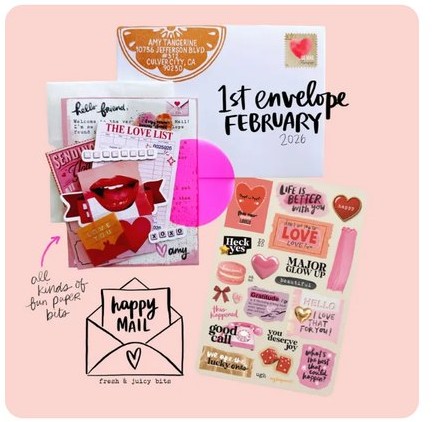
What a month of the club we run contains, from its own page (amytangerine.com/happy-mail)
What it means · opportunity 2 of 5
Sell the layer nobody sells.
Labels, the record, the exceptions. We built it once.
For Happy Mail we wrote the software the platforms stop short of: pull the paid batch, print labels in the creator’s handwriting font, record each envelope as mailed, hold the problem cases with a reason. Priced like the platforms, it is a small software business or a service for the top few hundred clubs.
Needs: one paying club at 500 envelopes a month that is not ours.
It took weeks to write and runs in minutes. Nobody sells it.
Sources: notes 5 and 6 (A11)
20 / 24
The club’s own page, October 18 2026 (maurakspain.com)
What it means · opportunity 3 of 5
A lettershop for the waitlisted.
Baker’s Dozen reports 6,000 members. A zine stopped signups at 2,000 with 3,600 waiting. Lettershops already insert, address and mail flat envelopes by the thousand. At a dollar an envelope the creator keeps $5.50 of $10 instead of $6.50, and stops packing.
Needs: one club with a waitlist willing to try it, and one lettershop quote.
The first customer has to be a creator who wants her evenings back.
Sources: notes 3, 5 and 7 (A11)
21 / 24
The club page of a creator with a million followers (amandaoleander.com)
What it means · opportunity 4 of 5
Four million followers, 740 envelopes.
Amanda Oleander, with a million followers, runs the biggest club we found at 22,000. Puuung, with four million, has 740. The creators who could grow close signups, start waitlists, or post less on purpose.
Needs: one creator willing to go from hundreds to thousands with help, and a service that ships the same envelope she would have packed.
The biggest audiences run the smallest clubs. Packing, not demand, sets the size.
Sources: notes 7 and 9 (A11)
22 / 24
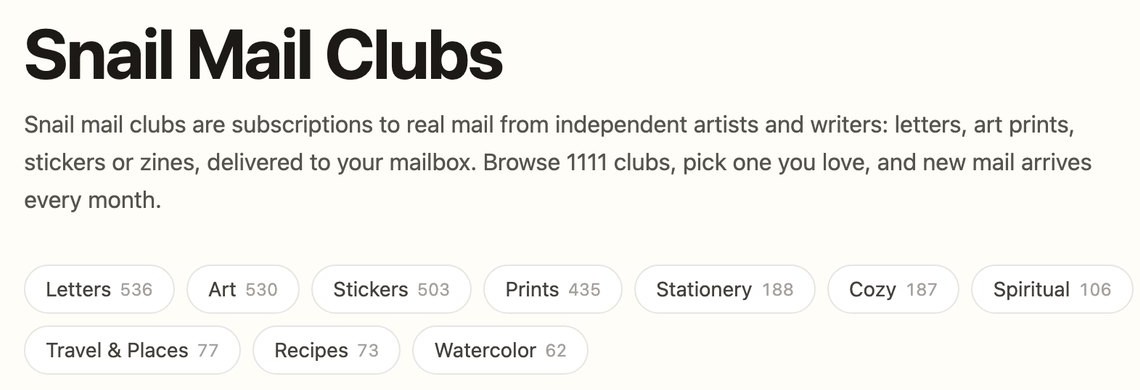
The MailClubly directory header, with its category counts (mailclubly.com, October 18 2026)
What it means · opportunity 5 of 5
Own the storefront, see the field first.
MailClubly lists 1,119 clubs and hosts 508.
MailClubly takes a fee on every club that sells through it and sees prices, cadence and growth before anyone else. It doubled overnight on September 23 by importing listings, so the first clean growth number is October to January.
Needs: that number.
The directory is also the checkout. Its owner sees every price and every signup first.
Sources: notes 6, 9 and 11 (A11)
23 / 24
What it means · the larger question
Is a real person worth more, or less?
A mail club is a monthly, paid, physical vote on that.
The scarcity reading
As more of the feed is generated, an envelope with handwriting in it proves a person is on the other end. The letter is already what subscribers stay for. If this holds, the field grows and hiring out the packing is the risk.
The substitution reading
Audiences attach to characters that are not people, and paying for a person fades with the feed that built it. If this holds, the field is a last-generation product: good for its operators, not much more.
Linslow is preparing for a content world that is mostly machine-made. This is one early place to measure what a real person is still worth.
Sources: notes 3, 5 and 7 (A11)
24 / 24
Linslow Industries
Here is the help we need.
An anchor club with a waitlist, willing to let someone else pack one month.
A lettershop quote for flat, untracked mail by the thousand.
One creator at hundreds who wants thousands, and will let us measure what stays.
A media company with a named voice and an owned audience, to run one with.
Introductions at MailClubly and Posthouse.
A reader who will tell us which of the five is wrong.
We bring the club, the software and the census. jc@linslow.com
Appendix
A1
Appendix
Appendix: the operating seat, the profiled clubs, the field’s edges, the stack, and the open questions.
Contents
A2
How we run Happy Mail
A3
The operating record, and three rules
A4
Where a subscriber count exists
A5
What is in the envelope
A6
What keeps subscribers
A7
The post office
A8
Minimum terms and prepaid packages
A9
Outside craft, and where it thins
A10
The stack
A11
Notes and sources
Method
In: creators running a monthly physical mail subscription: 1,312 listed clubs counted October 16 2026, recounted October 18 in a fresh process (1,323); fifteen profiled in May; one club from the inside. Out: venture-scale boxes, creators’ wider businesses, any club’s private numbers.
Passes: May, fifteen profiled; August, prices re-read; September, operators in conversation, quoted verbatim and unnamed; October, the census, the directories’ Wayback history, 31 live pages re-read and archived. “est.” marks an estimate. Happy Mail’s counts are “a few hundred” at the operator’s request. Nothing was paid for or placed.
Still being investigated
Public for nearly every club: a price (97%), a cadence (98%, almost all monthly), where it ships from (99%), an Instagram handle (62%). Enough to size and map the field. Not public:
Subscriber counts. Seven of 1,323 listings state one; we are asking operators.
Who stays past month three. No club publishes churn; Happy Mail’s record is the only one we have.
What a club earns. Four public cases and our own record.
The growth rate. Two listing pages in May, 1,119 in October; the first clean rate is October to January.
Whether the packing-table ceiling moves when a creator hires help.
Sources: notes 1, 2, 3, 9 and 11 (A11)
A2
Appendix · the operating seat
How we run Happy Mail: one cutoff, one stamp, one table, and the letter.
01 · One cutoffSign up by the 15th and you get this month's envelope; after that, next month's. One batch, one ship day, every month.
02 · One stampFlat and under an ounce, so the entire logistics chain is the post office. No packaging, no carrier account, no fulfillment partner.
03 · One tableHundreds to low thousands of envelopes packed by the creator and one helper, often a parent or spouse, in a few days.
04 · The letterA page in the creator's voice. It is the cheapest item in the envelope and the one subscribers stay for. A quarter of listed clubs promise one; nine of the fifteen we profiled include it.
Sources: notes 1, 3 and 5 (A11)
A3
Appendix · the operating seat
Eight ship cycles, 99 incident records, most in the migration month; three rules came out.
Figure 7Incident records by month, 2026
June was the platform migration; October is in progress. The creator hand-lettered every envelope in the first months; then the printer took over, with her handwriting as the font.
Three rules, and the month each one cost us
Count envelopes, not statuses. Each customer is owed the envelopes they bought minus the envelopes mailed. A six-month prepay is six envelopes, then it ends. Checking the count ended most disputes.
One cutoff, stated the same way everywhere. Sign up by the 15th for this month’s envelope: the FAQ, the welcome email and the system all say so. In the months they disagreed, we mailed extras and refunded people who thought they had missed one.
Check payment before printing labels. Every envelope in the batch is matched to a charge. Failed cards and mid-month pauses are held with a reason. Two subscriptions at one address are matched on email, product and recipient, so a gift is not deleted as a duplicate.
Sources: note 5 (A11)
A4
Appendix · the field
Seven of 1,323 listings state a count. The nine we have come from the press and the clubs’ pages.
Figure 8Every club with a public subscriber count, with its price and source
The two largest counts came from the clubs’ own pages and the three in the middle from the press. The field tells journalists what it does not tell its directory.
Sources: notes 1, 2, 7 and 9 (A11)
A5
Appendix · the profiled fifteen (paper craft)
In the fifteen profiled clubs: stickers in thirteen, a print in twelve, a letter in nine.
Figure 9Share of the fifteen profiled clubs including each item, May 2026
Sources: note 1 (A11)
A6
Appendix · the profiled fifteen (paper craft)
At census scale the one visible retention mechanic is the letter: 350 of 1,323 listings promise one.
Table 1Retention mechanics seen among the fifteen profiled clubs, May 2026
Mechanic
What it does
Seen at
Letter from the creator
A page in the creator's voice, every month
9 of 15; 350 of 1,323 listings
Closed enrollment windows
Turns a subscription into a status object; caps the pack
AnnMarie Henderson; three listings marked “currently full”
Punch card in the envelope
Rewards the streak; a reason to stay for the stamp
Lalanya Made
Past-issue archive for sale
Nostalgia upsell; new subscribers buy backward
Sadie's Stickers
Tiered envelope
A coloring page and a sticker for a 63% price uplift
Amanda Oleander; Reggie Design Co
Collector's double
A discounted second copy, one to use and one to keep
Found and Flowered
Every mechanic in the table sells the relationship, not the object. The letter is the only one visible from outside.
Sources: notes 1 and 9 (A11)
A7
Appendix · operator notes
Lost mail is under two percent: resend, do not track. Abroad, a Global Forever stamp and a price bump.
Lost mail
“I found, for me, it’s cheaper to just send another one than to refund them even.” A mail club operator, in conversation, September 2026
Figure 10What one lost envelope costs the operator
International
At Happy Mail, 0% to 1.3% of envelopes per cycle came back or were reported missing over five cycles. Abroad, Happy Mail ships to Canada, the UK and Australia on a Global Forever stamp ($1.75) at $16 a month; 146 of 1,323 listed clubs post free worldwide. In October we moved every international subscriber to Global Forever after this exchange:
“We sell [a] sticker sheet, it got flagged in customs to Europe as hazardous material and sent back to us because they saw the word Alcohol in there.” An operator, by email, September 2026
A resend costs $2.87 and a refund $9, and five Happy Mail cycles ran at 0% to 1.3% lost. The operators’ arithmetic is right.
Sources: notes 3, 4, 5 and 9 (A11)
A8
Appendix
Minimum terms make subscribers angry; prepaid packages sell.
"We've tried like saying, oh, if you sign up, you have to stay with us for three months, but people always get, you know, a little butthurt about that. So we just let them do whatever they want."
An operator · in conversation · September 2026
Packages that worked
One operator sold a full-year package in December only, closed it January 14, and will offer 2027 the same way at the current price before a small monthly increase. Quarter-aligned three-month packages after that, so joins do not drift.
And the one that did not
A three-month minimum at another made customers angry; dropped. Happy Mail's six-month package sells. The original $66 prepay ended after six envelopes by rule; the current $72 package renews unless the subscriber cancels.
The operator who dropped the three-month minimum sold a full year in December and closed it on January 14. Commitment sells when the customer chooses it.
Sources: notes 3 and 5 (A11)
A9
Appendix
Outside craft the shape holds in books, coffee and tea. Beauty chose product lines; the box wave folded.
Bookworm Box$39.99 a month, May 2026Colleen Hoover: signed novels through the author’s network; $1M+ donated. Its domain was parked for sale on October 18 2026.the person, then the exit
Onyx Coffee Lab$19 to $90 May 2026The top tier is beans the founder personally sourced.the person, priced
Brooklyn Tea$25 to $65 May 2026Every shipment carries a founder note on why this tea.the letter, again
Beauty and skincare$355M Naturium to E.l.f.Top creators chose product lines over recurring mail; no active creator-led mail subscription found.the exit was a brand
Plants, candles, wellness2019 to 2024 the box waveMostly folded by 2024. Churn at the operator level as well as the customer level: boxes, dimensional weight, 3PLs, inventory.boxes, not envelopes
Craft and paper$10 the median of 1,323 listed clubsFlat, under an ounce, made by the person whose name is on it. Low materials cost, a letter inside, and the packing is the marketing.unusually durable
Of the six, only craft and paper travels on one stamp; every other row carries a box, a bag or a bottle.
Sources: notes 1 and 9 (A11)
A10
Appendix
The stack: a storefront, then a subscription layer, then a spreadsheet. Only the top layer is visible at census scale.
Figure 11The three layers of a mail club’s stack, with the counts at each
Nobody sells the bottom layer. One operator reconciles by hand every morning after the 10:15 payments land; we wrote scripts; the rest do not say.
Sources: notes 1, 3, 5 and 9 (A11)
A11
Sources
Notes.
1 · Field research. Fifteen operator sites and pricing pages read live May 1 2026, with the cross-category sites named on A9 (prices as of May). Component audit and stack from the same pass; the die-cut count in Figure 9 includes Happy Mail.
2 · Prices. Re-verified on live pages August 26 2026 (Trinity, Meenoush, artxnikki, Oleander, Lalanya, TheCoffeeMonsterzCo), October 16 2026 (artsbytrinity.com, maurakspain.com) and October 18 2026 (31 pages re-read and archived). Lalanya converted from A$13; My Salty from A$12. Instagram followings read October 18.
3 · Operator conversations. Two mail club operators in conversation with Linslow, September 17 2026, recorded, and one by email September 29 2026. Quotations verbatim; the operators are unnamed by design and their figures are as stated to us (one club: launch mid 2025 at 50, about 1,000 by November, a waitlist by January 2026, 1,500 around April, nearly 2,000 in September).
4 · Unit economics. Materials: CNBC, April 30 2026 (Architecture Mail Club, $2 a mailer). Postage: usps.com business prices, read October 16 2026 (First-Class 1 oz $0.82; Global Forever $1.75). Card fees at 2.9% plus $0.30. Figure 4 is Linslow analysis from those inputs; the $18.3K data point is CNBC's, the creator's estimate for May. Margin at field prices ($8.88 to $10) is $5.40 to $6.50; the $6.50 parcel rate is a retail tracked rate, and $5 a tracked letter is as one operator quoted it. Resend $2.87 is a stamp, an envelope and the contents at cost.
5 · Happy Mail operating record. Linslow Industries, eight completed ship cycles February to September 2026 with October in progress: build runbooks, signed manifests, and a customer-service incident log (99 records on October 16 2026, 39 of them in the June migration month). The six-month flow write-up shared with operators September 17 2026. Hours in Figure 6 are one person's, from the fulfill logs where a script ran (the September record took 27 minutes for 361 rows) and from the operators' accounts otherwise, marked est. Counts withheld at the operator's request.
6 · Platforms. mailclubly.com and posthouseos.com, read October 16 2026, including pricing pages and FAQs. "You still make the art. You still pack the envelopes." is Posthouse's own line. Pricing for both re-checked the week of publication.
7 · Press and public cases. The Hustle, March 9 2026 (Christine Tyler Hill; The Tiny Post; Escargot). CNBC Make It, April 30 2026 (Trinity Shiroma; Kiki Klassen). This Is Tucson, March 23 2026 (Jamie Donnelly) and members.thisistucson.com, read October 18. letterclubs.com and mailclubly.com directories, October 16 and 18 2026.
9 · Directory census. mailclubly.com/clubs and letterclubs.com/directory counted by Linslow on October 16 2026 (1,312 unique clubs, 1,189 with a monthly price) and recounted October 18 in a fresh process with every page archived (1,323; the map, A4, A6 and A10 use the recount). Prices converted to USD at approximate October rates; a club can carry several tags; 58% of priced clubs sit in the $8 to $12 band shaded in Figure 2; platform detected from the club URL; seven clubs state a subscriber count; Instagram followings were read for 73 of the 100 most visible clubs. Re-run monthly.
10 · Images. Club photographs are the clubs' own, at the resolution their sites serve (artsbytrinity.com, maurakspain.com, thisistucson.com). Pages captured October 16 2026 and cropped to the element shown: mailclubly.com, maurakspain.com, amandaoleander.com, amytangerine.com. The packing-table frame on slide 8 is from the creator’s own public Instagram video, as published, cropped to the frame from the 362 by 640 file Instagram serves. The parcel on slide 9 is by Meanwell Packaging, CC BY 2.0, Wikimedia Commons. The map is drawn from Natural Earth outlines.
11 · Listing history, the unlisted field, and postage abroad. Wayback Machine captures of both directories, May 17 to September 24 2026, read October 18: mailclubly.com went from two listing pages in May to 520 on September 23 and 1,018 on September 24, an import, so the first clean growth rate is October to January. Capture-recapture on the two directories (1,119 and 429 listed, 225 in both) puts the whole field at about 2,100 clubs, a floor, since the same visible operators list twice. Postal letter rates read October 18: royalmail.com, deutschepost.de, canadapost-postescanada.ca, the Australia Post charges guide of September 1 2026; USPS October 16.
Prepared by Linslow Industries, October 2026. Questions to jc@linslow.com.
Prepared by Linslow Industries. Research and operating record from Happy Mail by Amy Tangerine, used with the operator's permission. Questions and the help we ask for on the last slide: jc@linslow.com.